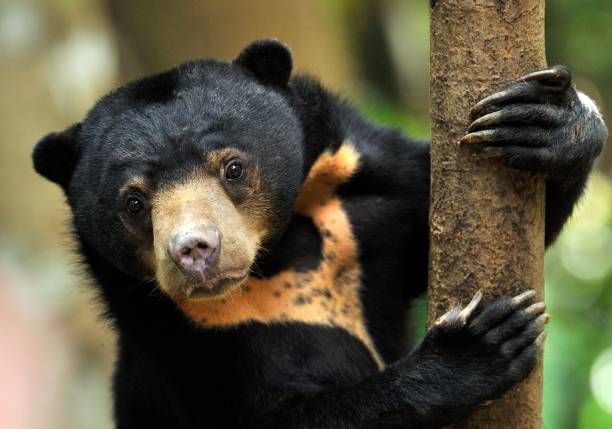
Sun Bears are the smallest bear species in the world, typically weighing between 55 to 150 pounds and standing at 4ft on their hind legs. These bears are natives to the tropical forests of Southeast Asia. They got their name due to their distinctive "crescent-shaped" orange to yellowish patch on their chest. One of their unique features is their extraordinarily long tongue up to 10 inches used to extract honey and insects from tree hollows and termite nests. Sun bears also possess very long, strong, curved claws and loose skin, adaptations that make them exceptional climbers and protect them from predators in tight spaces. Their short, sleek, dark black fur is another key adaptation that helps them keep cool in their warm, equatorial environment.
Sun Bears are found throughout mainland Southeast Asia, including countries like Malaysia, Indonesia, Thailand, and Myanmar. They primarily live in tropical and subtropical evergreen rainforests. Despite being omnivores, they are considered to be the most carnivorous of the bears, with a strong preference for high-protein insects and larvae. They use their claws to rip open termite mounds to find insects, but they also eat fruit, small vertebrates, and, famously, honey which also gave them the nickname of "Honey Bear". These bears are specialized foragers spending large amounts of time in the forest. Unlike the Brown Bear, they do not hibernate due to the constant availability of food in their equatorial range. Their climbing expertise is key to their foraging, as they often seek out bee nests and high-growing fruits in the canopy.
These bears are largely nocturnal, spending their nights foraging for food. They communicate by marking their territory by rubbing their scent on trees and biting into the bark with their sharp teeth. Unlike other bear species, Sun Bears don't hibernate due to to the warm climate and year-round availability of food. They sleep in the trees and create nests by bending branches. In their family life, Sun Bears usually give birth to one or two cubs in a tree. The cubs are entirely dependent on the mother and stay with her for up to three years while they learn necessary survival skills. This extensive period of maternal care is essential for teaching the cubs the complex climbing and foraging skills needed to survive in the dense tropical forest canopy. As a solitary species, interactions outside of the mother-cub bond are generally limited to breeding.
Sun Bears are currently listed as vulnerable by the IUCN Red List due to deforestation and poaching. Wildlife Trade also has role in this because their cubs are often captured for the exotic pet trade while others are illegally hunted for their gall bladders which are used in traditional Asian medicine. Their populations have declined by an estimated 30% over the last few decades, and still continues rapidly today. Conservation efforts are focused on protecting the remaining forest habitats and raising awareness about the cruelty of bear bile farming and the illegal pet trade. A major threat specific to their arboreal nature is the destruction of the forest canopy, which they rely on for foraging and nesting, thereby accelerating their displacement. Enforcement of anti-poaching laws and providing alternative livelihoods to local communities are also crucial strategies to mitigate the human-induced pressures on the species.