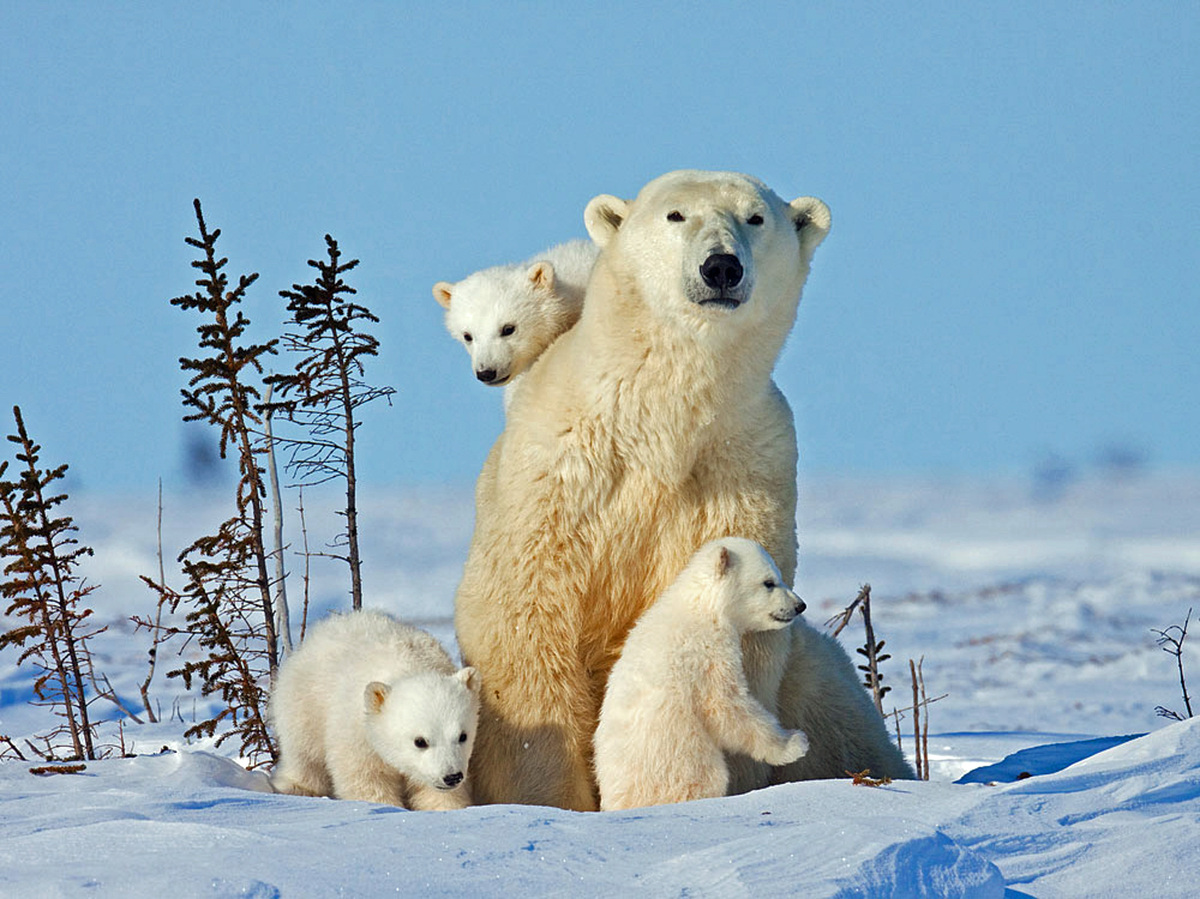
Polar Bears are natives to the Arctic region and are one of most well known bears on the planet. They originally evolved from Brown Bears over 400,000 years ago, but spilt off due to gradual adaption to the Arctic environment leading to their distinctive white fur, which provides camouflage in their snow habitat. Their scientific name means "maritime bear," indicating their dependence on the sea too. These bears have a thick layer of blubber and dense fur to keep them warm in below freezing temperatures. On the other hand, their large paws with long claws helps them walk on thin ice and snow. Their large paws are also slightly webbed, making them excellent swimmers—an essential trait for hunting seals in the open ocean and between ice floes.
These bears usually live in the sea ice of the Atlantic Ocean ranging in places like Arctic Circle, Canada, Russia, Greenland, and parts of Alaska. Polar Bears are the largest land carnivores, they primary feed on their prey such as Arctic foxes and Seals for their blubber which is essential for Polar Bears as energy reserves. These bears use a still-hunting technique by waiting patiently near breathing holes in the ice for seals to come up to the surface for air. Although when the ice melts in the summer, they will consume whatever food is available like vegetation or bird eggs even though they provide little nutritional value compared to seal blubber. Their life is inextricably linked to the sea ice, which serves as their main platform for hunting and travel, making them a marine mammal under the law. Due to their highly specialized diet, they are classified as hypercarnivores, meaning over 70% of their diet is meat.
Polar Bears are mainly solitary animals except mothers with cubs or mating pairs. Polar bears are known for being quite agressive, males tend to be more aggressive towards each other when it comes to food. Their family life is quite incredible. They are also great swimmers who can travel long distance across the sea ice throughout the year in search of food. In their family life, pregnant females will dig maternity dens in deep snow drifts on land or large ice floes, where they give birth to one to three cubs in late autumn to early winter. Their cubs are born blind and helpless, they remain with their mothers for about two and half years to learn survival skills like hunting. This ensures they are well-equipped to survive in the harsh arctic enviorment on their own.
Polar Bears are currently classified as vulnerable by the International Union for Conservation of Nature (IUCN) due to habitat loss and human conflict. Climate change has played a major role in habitat loss leading to melting of their sea ice that is significant for their hunting grounds. As ice melts, scientist believe that two-thirds of their population could disappear by the mid century if these trends continue. Their classification as a marine mammal dependent on sea ice makes them a global symbol of the effects of climate change. In addition to the primary threat of sea ice loss, they also face dangers from pollution, which accumulates in their fatty tissues, and oil and gas exploration in the Arctic. Conservation strategies are inherently linked to global efforts to mitigate climate change, as well as local management to reduce conflicts when bears are forced onto land to search for food.