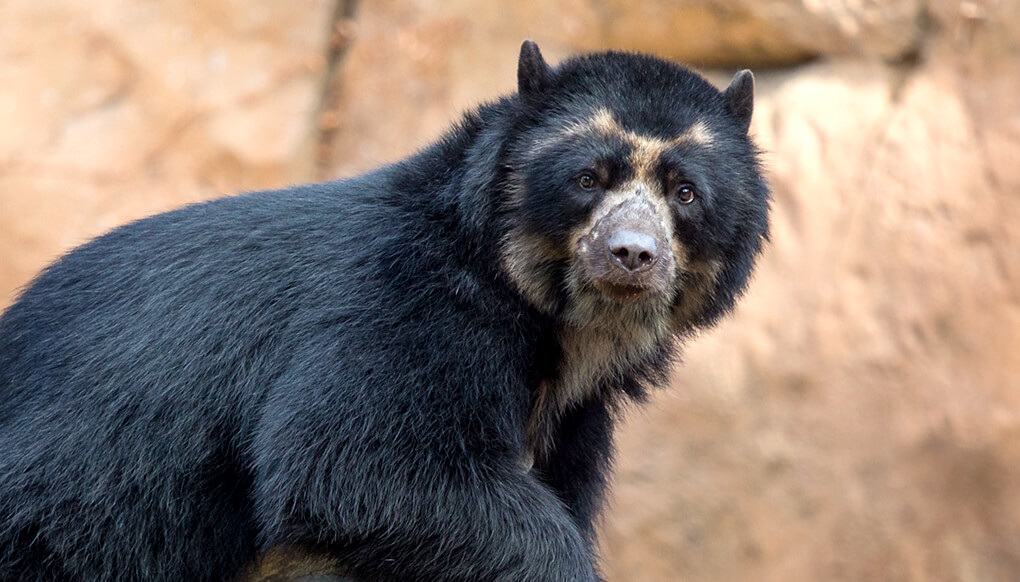
The Andean Bear, also known as the Spectacled Bear, is native to the Andean region in South America. They are the only bear species found in South America and are unique for their distinctive facial markings. The species originated in South America from an ancestor known as the extinct Giant Short-Faced Bear known as Tremarctinae. They have thick shaggy coat that is usually black or very dark brown. They get their common name of "Spectacled Bear" from the distinctive whitish markings around their eyes, face, neck, and chest. The pattern of these "spectacles" are unique to each bear. This species is considered a mid-sized bear, with males being significantly larger, often weighing up to twice as much as the females. They also possess a relatively short snout compared to other bears, a characteristic retained from their lineage in the short-faced bear subfamily. Their strong, curved claws and long forelimbs make them highly arboreal, allowing them to spend much of their time climbing and foraging in trees.
Andean Bears can adapt to a variety of habitats across the Andes at elevations ranging from 2000 to over 4,000 meters. They are commonly found in cloud forests in places such as Venezuela, Colombia, Ecuador, Peru, Bolivia, and northern Argentina. Andean Bears are mainly omnivores, however it is one of the most herbivorous bear species, with plants making up about 90% of its diet. These bears opportunistically consume small animals such as insects, rodents, and occasionally carrion. They are also known to raid agricultural crops like maize, which often leads to conflict with humans. Unlike many other bear species, Andean Bears do not hibernate because food is generally available year-round in their temperate mountain habitats. Their reliance on fruit makes them critical seed dispersers, earning them the nickname "gardeners of the forest."
These bears are quite shy and often avoid human contact. They are mainly active during the day and skilled climbers who spend a significant amount of time in trees where they forage and escape danger. They are known to construct "nests" in the tree canopy by bending and breaking branches, which they use to eat and rest. Mating season occurs between March and October, then females give birth to one to two cubs. Their cubs are born helpless and stay with their mother for up to two years for protection, learning skills like climbing and foraging before venturing out on their own. Unlike other bear species that may be fiercely territorial, Andean Bears are generally solitary but not aggressively territorial, and they may even gather peacefully in small groups when a large, abundant food source is found. In captivity, these bears can live into their late twenties or early thirties, though their exact lifespan in the wild is currently unknown.
The Andean Bear is currently classified as vulnerable by the IUCN Red List. There are fewer than 18,000 bears of this species are estimated to survive in the wild due to illegal hunting and deforestation. Initatives like the Andean Bear Conservation Alliance (ABCA) is an significant organization for research, monitoring, and conservation planning for wild Andean Bear populations. The primary threat to their survival is habitat loss and fragmentation caused by agricultural expansion, logging, and infrastructure development. Because they require large, connected areas to roam and forage, the destruction of their cloud forest habitat severely limits their ability to thrive. Illegal hunting, or poaching, also poses a threat, as bears are sometimes killed in retaliation for raiding crops or for the black market trade of their parts, particularly the gall bladder for traditional medicine. Conservation efforts, therefore, focus not only on protecting their habitat but also on working with local communities to reduce human-bear conflict.