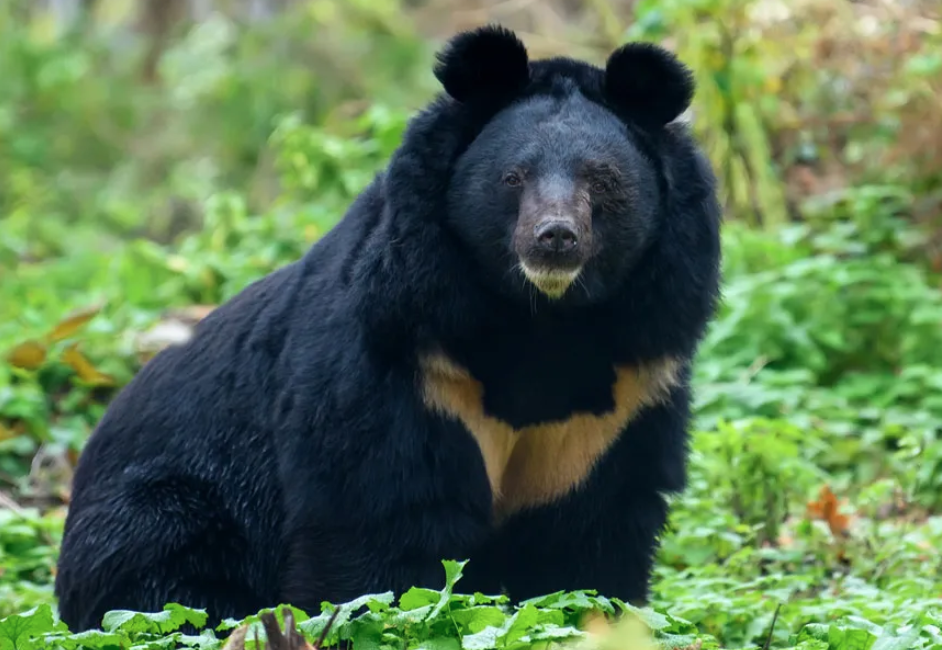
The Asiatic Black Bear, also known as the Moon Bear due to its distinct yellowish-white crescent-shaped "moon" marking on its chest, is found exclusively in Asia. According to fossil records, the Asiatic Black Bear were historically present in Europe. This bear first originated from a hybrid speciation event between its two groups of ancestors. From North America, the ancestor of the modern brown bear, polar bear and American black bear was crossbreed with the ancestor of the Sloth Bear and Sun Bear occuring in Eurasia. Asiatic Black Bears have coarse black fur, light colored muzzles, and a heavy body with curved claws which are great for climbing. Their large, rounded ears are also a distinguishing trait. They are an intermediate size among the bear family, typically smaller than the Brown Bear but larger than the Sun Bear. Scientifically known as Ursus thibetanus, their powerful limbs and claws make them highly arboreal, similar to the Sun Bear, as they spend significant time foraging and resting in trees.
These bears live in moist forests and steep mountain regions across Asia. They often spend their time in trees in search for vegetation, fruits, and insects. These bears migrate to warmer areas during the winter months, in contrast to the summer where they travel to higher elevations. The Asiatic Black Bear is omnivorous and primarily consumes wide variety ranging from nuts to certain small mammals. During the winter, they rely on stored fat reserves while in hibernation. Their dexterity and climbing ability are crucial for accessing food sources high in the canopy, making them effective foragers in their varied forested environment.
Asiatic Black Bears are typically aggressive to humans, especially when threatened or surprised. They are quite reclusive and are mainly nocturnal who enjoy to forage at night. They are also strong swimmers and tree climbers! In their family life, the mother bear gives birth to one to four cubs and raises them on her own. The mother bear is very protective over cubs, however after teaching them the essential survival skills for two to three years, she will leave them to fend for themselves. The prolonged maternal care ensures the cubs are fully prepared to navigate their complex mountainous environment and avoid conflicts with other bears or humans.
The Asiatic Black Bear is currently listed as Vulnerable on the IUCN Red List. Despite these bears being legally protected in 18 countries, they still face threats from habitat loss, deforestation, and illegal hunting. Their population has declined around 30-40% over the last three decades. Restoration projects from South Korea's Jirisan National Park aim to breed and reproduce the species in Mt. Jirisan. The restoration of the Asiatic Black Bear holds as a symbol for endangered wildlife restoration policies especially in South Korea. The long-term success of these conservation efforts depends on controlling poaching, securing vast corridors of habitat across their range, and reducing human-bear conflict, which is often exacerbated by the fragmentation of their forest home.